
Author

admin

Browsing

Introduction

Digital marketing has its own set of metrics that marketers follow closely, and the Click-Through Rate (CTR) is one such metric. To put it simply, CTR is measured as the number of people who click on a link, ad, or call-to-action after viewing it. When CTR goes high, it is likely that your content is connecting with your audience.

But why is CTR so crucial? The slightest increase in CTR might result in massive growth in traffic, leads, and revenue eventually. Over the past few years, AI has intervened with the aim of revolutionizing the process of maximizing CTR by marketers. To predict user behavior and to tailor messages, AI is already becoming a game-changer. We will discuss the top five advantages of applying AI in order to increase CTR.

1. Improved Targeting

Better targeting is one of the greatest benefits of AI. When marketing in the traditional setting, it was common to segment your market with simple demographics such as age, location, or gender. This, however, is taken a step further by AI.

AI may recognize patterns that a human being may overlook by studying user behavior and preferences. An example is that it is able to sense the kind of content a given user interacts with most, or what items they will tend to buy in the future.

In addition, AI-based solutions, such as Google Ads Smart Bidding, HubSpot, or Salesforce Einstein, can assist marketers in providing content to the appropriate audience at the appropriate moment. Targeting using AI tends to create more engagement and generate a better CTR, as the people who are targeted are those who are interested in the content.

2. Enhanced Personalization

Here, personalization comes after knowing who your audience is. More users will likely click on personalized content, as it will be more appealing to them.

AI can be utilized to customize messages by using user information, e.g., browsing records, buying patterns, or other interactions with earlier campaigns. To illustrate, Netflix recommends something based on your viewing behaviors using AI, and e-commerce platforms recommend things based on your browsing history.

In real-life practice, AI-based customization can increase CTR significantly. An example of this is a fashion retailer sending personalized emails with products a user may be interested in, which will have more clicks and conversions than any generic email.

3. A/B Testing Automation

Testing alternative versions of ads or content has always been one of the major ways of enhancing CTR. Conventionally, this A/B testing would take days or weeks. AI changes the game by automating the process, making it faster and more accurate.

AI is capable of executing several variations at once, analyzing results in real-time, and suggesting improvements. This speed and accuracy enable marketers to discover what works best in a short time without having to guess.

Companies that applied AI in A/B testing have stated that they make decisions faster and have seen their campaigns perform better due to the constantly learning system, which engages in the most successful variations.

Beginners often struggle with knowing which keywords to focus on. You can click here to see a simple way to track keywords across multiple pages.

4. Predictive Analytics

The next advantage of AI is predictive analytics. In simple terms, predictive analytics involves the use of past data to determine future behavior. This can be viewed as an indication of which campaigns marketers ought to expect to have a higher CTR.

By analyzing trends in previous campaigns, AI can predict outcomes to help marketers better allocate budgets and resources. For example, an online firm could learn that a specific type of promotional email works best on Fridays and tailor their programs accordingly.

Some companies have been able to utilize predictive analytics effectively to raise CTR and overall engagement, demonstrating that predicting consumer actions can be more efficient than reacting to them.

5. Real-Time Adaptations

Lastly, AI excels at real-time adjustments. Digital marketing is volatile, and user behavior may shift within seconds. Traditional approaches are not always capable of responding quickly, but AI can process real-time data and implement instant campaign adjustments.

This could involve changing ad bids, swapping content, or adjusting messaging to fit current preferences. This means content is more relevant and timely, resulting in increased CTR. Firms that have applied AI to real-time optimization have achieved measurable engagement, sometimes within hours of launching a campaign.

Conclusion

In conclusion, AI has five major advantages to maximize CTR:

  • Better targeting through improved audience segmentation

  • Greater personalization for users

  • Faster and automated A/B testing

  • Intelligent campaign forecasting

  • Real-time adjustments to capture maximum interest

With the further development of AI, the possibilities to boost CTR and achieve improved marketing outcomes will increase. Use of AI is not a choice, but a necessity for marketers who wish to remain at the forefront. Begin experimenting with AI tools now and watch your CTR rise.

Custom software development shapes modern businesses for success. Companies face rapid changes that demand smart solutions. Investing in adaptable tools allows growth without disruptions. Unlike off-the-shelf programs, custom solutions fit unique workflows. They evolve as business needs change over time. Every business seeks stability and flexibility in software solutions. Proper infrastructure today secures performance tomorrow. Custom software becomes a strategic asset rather than a simple tool. Businesses gain a competitive edge through foresight and preparation.

Scalability That Supports Expansion

Custom software development scales with business growth. As companies add new services, software can expand. There is no need to replace it frequently. Systems adapt to increasing data volumes and user loads. Sometimes software cannot handle sudden growth without planning. This flexibility saves time and financial resources. Companies experience smoother operations as demands increase. Software must anticipate future requirements for efficiency. Scalability ensures that systems remain reliable over long periods.

Adaptability for Changing Markets

Markets change rapidly and demand responsive solutions. The custom software development allows modifications to match trends. Businesses stay relevant with software that adjusts quickly. Sometimes off-the-shelf solutions fail in new scenarios. Adaptable software keeps companies competitive and resilient. Businesses can integrate new tools without major disruption. Software flexibility supports innovation and fast decision-making. Custom solutions become a platform for continuous improvement. This approach protects long-term growth against market uncertainty.

Long-Term Investment Benefits

Custom software is a long-term investment with high returns. It reduces recurring costs compared to standard software. Businesses avoid licensing fees and rigid updates. Sometimes initial costs appear high but pay off later. Systems built for long-term use remain reliable and effective. They reduce the need for frequent replacements.

Integration and Efficiency Gains

Custom software integrates with existing tools and processes. Companies benefit from improved workflow efficiency. It connects departments and centralizes data seamlessly. Sometimes generic software creates silos and slow processes. Integration ensures that all teams work in harmony. Automation and data sharing reduce errors and save time. Custom software development supports coordinated and optimized operations. Businesses can achieve measurable improvements in performance. This efficiency drives higher productivity and competitiveness.

Conclusion
Custom software development secures growth for the future. Its scalability, adaptability, and long-term value protect businesses. Companies can face market changes without disruption. Investing in custom solutions ensures that systems evolve. Businesses gain strategic tools that support every stage. Efficiency and integration strengthen operational success. Custom software becomes a core asset for growth. Choosing smart solutions today prepares companies for tomorrow.

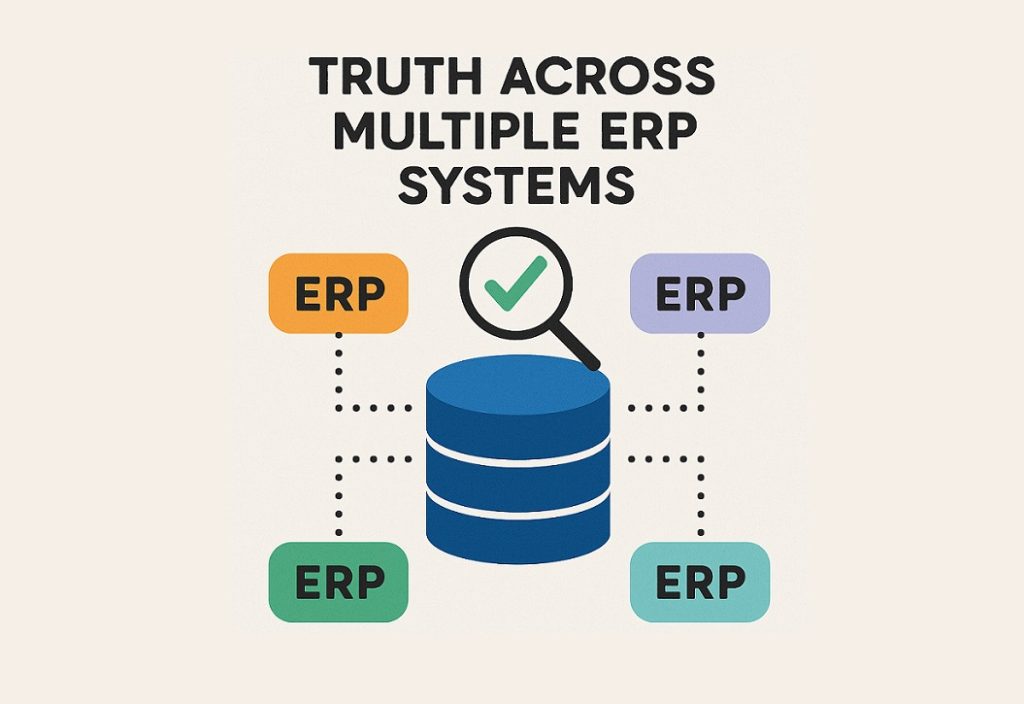
In today’s fast-paced digital economy, businesses are increasingly relying on Enterprise Resource Planning (ERP) systems to streamline operations, manage financials, and enhance collaboration. But as companies expand globally, mergers, acquisitions, and diverse business units often lead to multiple ERP systems operating in silos.
This fragmented setup results in data inconsistencies, reporting challenges, and misaligned decision-making. That’s why achieving a single version of truth (SVOT) has become a top priority for organizations seeking efficiency and competitive advantage.

What Does “Single Version of Truth” Mean in ERP?

Data Accuracy and Consistency

A single version of truth ensures that all departments, from finance to supply chain, access the same accurate data without duplication or discrepancies.

Transparency for Decision-Makers

Leadership teams can make data-driven decisions confidently when they rely on a unified, consistent source of information.

Streamlining Cross-Department Collaboration

When ERP systems speak the same “data language,” collaboration improves, reducing friction across finance, HR, manufacturing, and logistics.

Challenges of Managing Multiple ERP Systems

Data Silos and Fragmentation

Each ERP system stores data differently, leading to silos that limit visibility and increase inefficiencies.

Integration Complexity

ERP systems often differ in architecture, making integration a daunting and resource-heavy process.

Compliance and Security Risks

Fragmented ERP environments can increase the risk of regulatory non-compliance and data breaches.

Why Businesses Need One Truth Across Systems

Organizations that fail to unify ERP data risk misreporting, poor forecasting, and delayed decision-making. A single version of truth enables operational alignment, ensuring every department works with one truth across systems.

Key Strategies to Achieve a Single Version of Truth

Standardizing Data Models Across ERPs

Unifying naming conventions, codes, and data structures across ERP platforms ensures consistency.

Implementing a Master Data Management (MDM) Solution

MDM acts as a central hub, cleaning and governing data to ensure accuracy.

Leveraging APIs and Middleware for Seamless Integration

Modern APIs and middleware solutions enable different ERP systems to communicate effectively.

Real-Time Data Synchronization

Batch updates often cause lags. Real-time synchronization ensures that all stakeholders access the most current data.

Cloud-Based ERP Integration Platforms

Cloud solutions offer scalability, flexibility, and cost-effectiveness for unifying ERP systems globally.

The Role of AI and Automation in ERP Unification

AI-driven platforms like routineai.com are revolutionizing ERP integration. Automation reduces manual errors, accelerates reconciliation, and ensures continuous monitoring of data integrity.

Case Studies: Companies Achieving Unified ERP Data

  • Global Retailer: Consolidated five ERP systems into a unified cloud-based solution, reducing reporting time by 40%.
  • Manufacturing Firm: Implemented MDM and AI-driven integration tools, achieving real-time visibility into supply chain operations.

Tools and Platforms That Simplify ERP Data Integration

Some leading tools that support ERP integration include:

  • Informatica MDM
  • MuleSoft Anypoint Platform
  • SAP Cloud Platform Integration
  • Oracle Integration Cloud

How to Measure Success in Achieving a Single Version of Truth

Improved Reporting Accuracy

Reports should match across departments without discrepancies.

Faster Decision-Making

Leaders can act quickly with accurate, real-time insights.

Enhanced Compliance and Governance

Unified ERP systems reduce audit risks and regulatory issues.

Best Practices for a Smooth ERP Data Unification Journey

  • Start with a clear data governance framework.
  • Align IT and business teams early.
  • Invest in scalable integration platforms.
  • Continuously monitor and refine processes.

Common Mistakes to Avoid When Integrating Multiple ERP Systems

  • Ignoring change management.
  • Overlooking hidden costs.
  • Attempting a “big bang” migration without phased execution.
  • Failing to address data quality issues at the start.

FAQs on ERP Data Unification

Q1: Why is a single version of truth important for ERP systems?

It ensures accuracy, improves collaboration, and supports faster decision-making.

Q2: Can small businesses benefit from ERP data unification?

Yes, even SMEs can improve efficiency and reduce errors by integrating ERP systems.

Q3: How long does ERP data unification typically take?

It depends on system complexity, but most projects span from 6 months to 2 years.

Q4: What is the role of AI in ERP unification?

AI automates data validation, integration, and monitoring for continuous accuracy.

Q5: Which industries benefit most from ERP unification?

Manufacturing, retail, healthcare, and financial services often see the highest ROI.

Q6: What’s the first step toward achieving SVOT?

Start with a data audit to identify silos, inconsistencies, and integration needs.

Conclusion: Building a Future-Ready ERP Strategy

Achieving a single version of truth across multiple ERP systems is no longer optional—it’s essential for staying competitive. With standardized data, real-time integration, and AI-driven tools, businesses can unlock efficiency, improve decision-making, and build a future-ready ERP strategy.

Imagine a grand orchestra preparing for a performance. Each instrument must be tuned precisely; if even one is out of key, the entire symphony suffers. Data consistency plays the same role in AI and machine learning models. When information is harmonised, algorithms perform beautifully. When it is inconsistent, the outcome becomes noise.

Optimisation acts as the conductor, ensuring every piece of data aligns, synchronises, and supports the larger performance. Without it, models risk learning from fragmented, misleading, or incomplete information.

Why Consistency Matters in AI

Inconsistent data is like a map with missing roads and misplaced landmarks. A traveller may still reach the destination, but with detours, delays, and confusion. For AI, inconsistent data produces similar chaos: biased results, inaccurate predictions, and weakened trust in outcomes.

Optimisation techniques—such as feature scaling, deduplication, and schema alignment—serve as corrective measures, restoring clarity and order. These practices ensure that models train on reliable, comparable data, ultimately leading to results that reflect reality rather than distortion.

Structured programmes, such as a data scientist course, often introduce learners to these challenges. They highlight how models trained without consistent inputs may look promising at first but fail disastrously when deployed in the real world.

The Role of Optimization Techniques

Optimisation in AI isn’t just about squeezing better performance; it’s about enforcing discipline. Techniques like gradient descent fine-tune model parameters, while data preprocessing strategies align values across diverse datasets.

Consider normalisation: just as currencies must be converted into the same denomination before comparison, data features must be scaled to comparable ranges. Similarly, imputation fills missing values, much like a librarian replacing lost pages in a book to preserve the integrity of the story.

For aspiring professionals, enrolling in a data science course in Pune provides hands-on exposure to these optimisation methods. Through case studies and projects, learners see how consistency transforms raw data into a foundation for powerful, trustworthy models.

Balancing Scale with Accuracy

Optimisation also means walking a tightrope between scale and precision. Large datasets offer depth, but without optimisation, they may introduce redundancy or contradictions. Conversely, heavily curated datasets may be precise but lack the diversity models need.

The solution lies in striking a balance: designing pipelines that scale efficiently while maintaining accuracy. Distributed data systems, automated validation scripts, and version control ensure that data consistency doesn’t collapse under the weight of growth.

These lessons are often reinforced in a data scientist course, where students learn to manage trade-offs between performance and reliability in real-world projects.

Optimisation for Evolving Data

Data is never static. Customer behaviour shifts, sensors generate new signals, and markets evolve. Ensuring consistency in such a dynamic environment requires continuous optimisation. Monitoring systems, automated retraining, and feedback loops help models stay aligned with changing realities.

This adaptability is like a sailor constantly adjusting sails to match the wind. Without such adjustments, models drift away from accuracy, no matter how well they performed initially.

Professional programmes, such as a data scientist course in Pune, prepare learners for this challenge by teaching them how to design pipelines that evolve gracefully. They emphasise the need for agility, so models remain consistent and relevant even in fast-changing domains.

Conclusion

Optimisation is more than a technical process—it is the art of ensuring that every note in the orchestra of data plays in harmony. By enforcing consistency, it enables AI and machine learning models to deliver reliable, accurate, and actionable outcomes.

For organisations, the lesson is clear: without optimisation, data is just noise. With it, the same information becomes the foundation of trust and innovation. For professionals, mastering these techniques ensures they can guide AI systems with precision, balancing the speed of automation with the wisdom of human insight.

Business Name: ExcelR – Data Science, Data Analytics Course Training in Pune

Address: 101 A ,1st Floor, Siddh Icon, Baner Rd, opposite Lane To Royal Enfield Showroom, beside Asian Box Restaurant, Baner, Pune, Maharashtra 411045

Phone Number: 098809 13504

Email Id: enquiry@excelr.com