Author

Hunter Wightman

Browsing


When selecting whether or not their email will reach the inbox, Internet service providers (ISPs) assess several factors. Subscriber engagement is one of these factors to examine.

Subscriber engagement is influenced by the subscribers’ interest in the content and the frequency with which it is delivered. Another important aspect of having an engaged list is having a list with active, legitimate email addresses.

There is no way for someone to participate or interact with the campaign if users aren’t sending to legitimate email addresses. It also serves as a warning to ISPs regarding their mailing methods.

The cleaning of an email list is referred to as email hygiene. It comprises deleting invalid and inactive e-mail addresses from their mailing list and just sending useful communications to their subscribers. Simply said, email hygiene entails sending the appropriate emails to the appropriate recipients.

Spam complaints have been on the rise as e-mail marketing has grown in popularity. It is a major issue that has resulted in financial scams in which consumers have lost hundreds of dollars or more as a result of fraudulent letters.

Another reason to keep the email list clean is to ensure that only valuable material is available on their platform. To do this, email service providers now track people’s responses to emails they receive in their inboxes. Furthermore, users must maintain a positive sender reputation. Many un-subscriptions, inactivity, and spam reports will make ESPs believe they are not a trustworthy service provider. This increases the likelihood that their emails will not reach the sender’s mailbox.

Why is Email List Hygiene Important?

Users may send customized emails to their email lists and obtain greater engagement and results by segmenting or categorizing their lists regularly. Personalizing their emails, not just by including the customer’s name, but also by delivering recommendations and content relevant to their journey, will strengthen their relationship and generate trust with their consumers. With the rise in email marketing, there is a lot of competition out there these days, so making their emails stand out is crucial.

When Should an Email List be Cleaned?

Users should clear their email lists at least once every six months, according to the usual guideline. Declining open and click-through rates, on the other hand, could indicate that they have a big number of unsubscribed accounts or a disinterested audience. When this happens, check to see if spam complaints and unsubscribe rates have increased. If a user’s numbers are starting to fall, they should begin working on cleaning up their list as soon as feasible.

Improve their ROI by Cleaning Up Their Email List Hygiene

A clean email list is critical for the success of their email marketing initiatives, regardless of what area their company is in. Best practices for email list maintenance can help email campaigns achieve a higher ROI and, as a result, more sales. Users will be able to not only efficiently engage with their consumers but also obtain a greater grasp of who they are and what makes them happy. As a result, the brand value and trust that users develop with their customers will improve.
The digital world is evolving at a rapid pace and is encouraging businesses to adopt new technologies, and devise effective business strategies to stay ahead of the competition. Apache Kafka is one such technology that provides businesses with a competitive advantage. Today, examining data/files in real-time and developing business insights from the gathered data is becoming an important function in the world of data analytics. Real-time analytics of data assists in making qualitative assessments at the right time. That is what makes Kafka so important for businesses, both big and small.

How Does Kafka Help To Stream Data In Real-Time?

In order to comprehend how Kafka’s message broker assists data streaming in real-time, it is important to first understand the structure of Apache Kafka. Kafka works as a bunch that stores data from one or more servers, called producers. The data is segregated into various segments/blocks called topics. Every topic gets indexed and saved with a timestamp. It processes the streaming and real-time data along with Apache Spark, Apache Storm, and Apache HBase. Kafka has primarily four APIs, namely:

  1. Producer API – Lets the application put out the data stream to one or more Kafka topics.
  2. Consumer API– Lets the application sign up to one or more topics and handle the records stream.
  3. Streams API– Transforms input stream into output and generates results.
  4. Connector API– It enables constructing and functioning of reusable consumers or producers. 

Organisations broadly use Kafka for creating real-time data pipelines as it can mine high-volume and high-velocity data. This high-velocity data is distributed over a real-time Kafka pipeline. The data that is put out is subscribed using platforms for streaming such as Spark or through any Kafka connectors like Java Kafka connectors, Node Rdkafka. The subscribed data is then moved to the control panel using APIs.

Source


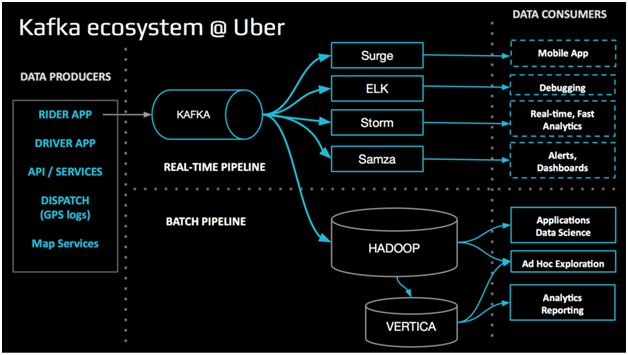
Uber is a prime example of a brand that successfully leverages Apache Kafka. Apache Kafka continually empowers over 300 microservices in Uber and various workflows such as pub-sub message buses. This is for the purpose of passing event data from the rider and driver apps, thus streaming database changelogs to subscribers and processing data from Hadoop data lake.

Advantages of using Kafka-

  1. Kafka can manage high data volumes & is a scalable, highly dependable system, and error-tolerant.
  2. Kafka is a publish-subscribe, distributed messaging system. This system is called brokers in Kafka, which makes it superior to other similar message brokers such as AMQP, JMS, RabbitMQ.
  3. Kafka can handle real-time, high-velocity, data unlike message brokers such as AMQP, JMS, RabbitMQ.
  4. Kafka is a very robust system as the data is constant and cannot be simulated.
  5. Kafka can manage messages with low dormancy.

Kafka can be advantageous across financial and business sectors for better, real-time analytics.

Although Kafka is benefitting numerous sectors, let us look at one such sector that is leveraging this tool and the two specific threats that apply to this sector where Kafka plays a crucial role, i.e., data analytics in financial services.

Fraud Detection-

Payment frauds and money laundering are the harsh realities in the financial industry. Therefore, financial enterprises need to be vigilant as such dangers can have a drastic impact.

Kafka can help financial institutions protect themselves by moving to real-time rules. Systems can be trained to absorb behaviour patterns by themselves by going through a large amount of old data, followed by algorithms that need to be fed, like clustering, which helps systems to find out what a usual behaviour is. It benefits financial institutions to detect and identify deceits with ease.

Trading-

Trading involves data analysis along with mind presence to be successful. There are unscrupulous strides that could be unsafe for your business. Kafka can be used as a very useful observation tool that identifies the meekest types of manipulation and warns controllers to take remedial actions.

So by now you would have realised the importance of Kafka and how it can help your business to expand. But switching over to a new technology like Kafka is not easy and it is always preferable to partner with reputed firms like Knoldus. We are a professionally-driven company and comprise a talented team. If you need any help regarding the application of Apache Kafka please contact Knoldus for more information.