Author

Trinidad Grimshaw

Browsing

I’ve spent the last few years exploring AI tools for professional branding, from automation platforms to image enhancement software. I’ve tested dozens of AI headshot tools, combed through hundreds of user results, and spoken with teams who’ve implemented them across their entire workforce.

Here’s what I’ve found.

Most tools look good at first. But dig deeper, and you’ll hit pixelation issues, identity mismatches, or inconsistent styles. That’s why I don’t just recommend a tool because it’s popular. I recommend it when it actually delivers reliable, usable headshots that you won’t hesitate to put on your LinkedIn or portfolio.

That’s what led me to PhotoPacks.AI.

After reviewing their features, results, and customer experience, I can say confidently they’re one of the most solid picks out there. If you’re looking for a free ai headshot generator that produces clean, professional results fast, they should be at the top of your list.

What Makes PhotoPacks.AI Different
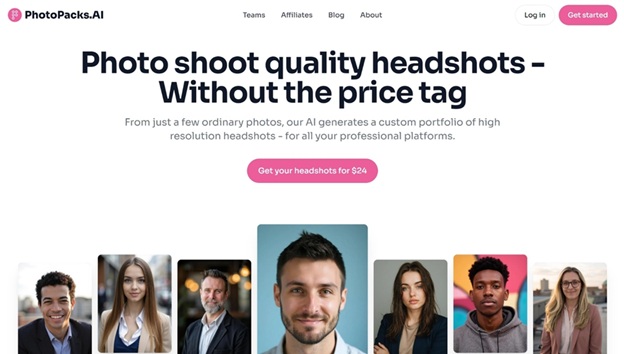
A lot of platforms claim to offer professional-grade AI headshots. But only a few actually produce something that looks like it came from a real studio. PhotoPacks.AI hits that mark. They’ve created over 900,000 headshots to date, and it shows. The quality of their AI is consistent, realistic, and polished.

You upload ten casual selfies from different angles and expressions. Within 24 hours, they send back more than 100 personalized images. These are high-res, sharp, and varied enough for any use case.

And it’s not just about the volume. Each headshot set is customized to your features and built from a model trained on your images alone. That means no awkward face blends or mismatched expressions.

Real Practical Benefits You’ll Notice

Let’s say you need a clean profile image for your site, LinkedIn, or a client pitch. Booking a photographer, setting up a shoot, and editing photos could easily cost $300 or more. That’s before even thinking about your schedule or what to wear.

PhotoPacks.AI eliminates that process. You don’t need makeup, lighting, or a wardrobe change. Just upload regular phone pics, and the tool handles the rest. It’s fast and budget-friendly. Pricing starts at $24. Not bad for 100+ headshots.

They also offer bulk options. If you run an agency, remote team, or startup, this is a legit solution to keep your branding consistent across the board. Their group package discounts make it ten times cheaper than hiring a photographer for everyone.

What About Reliability and Privacy?

This part matters to me, especially when uploading personal photos.

PhotoPacks.AI deletes all uploads and training data after your headshots are delivered. No files are shared, stored, or reused. You also get secure payment processing through Stripe, which adds another layer of confidence.

Their full satisfaction guarantee is also worth noting. If you’re not happy, you can request a refund within seven days. It’s not a trial. It’s a real safety net.

From what I’ve seen, that level of service isn’t common in this space.

Versatility Beyond LinkedIn

I usually talk about headshots in the context of personal branding. But this tool can go further.

PhotoPacks.AI also produces artistic, stylized outputs that can be used for gifts, greeting cards, social media content, or merchandise. Upload a photo of your dog, your kid, or yourself, and you’ll get dozens of creative variations in a single batch.

That versatility makes it useful even outside of work contexts.

Why I Recommend Them Over Other Options

You’re not just paying for AI. You’re paying for speed, accuracy, and control. Other tools take longer, give fewer images, or lack the polish you need for a professional presence.

PhotoPacks.AI combines quality and affordability without asking you to compromise. You control the inputs. They deliver outputs that are actually usable, not just novelty edits.

It’s hard to find that balance.

Most importantly, their model feels refined. It doesn’t make the common mistakes you see with other AI tools like distorted facial features, inconsistent lighting, or strange shadows. It’s well-trained, and the results reflect that.

Final Thoughts

If you’ve been burned by generic AI headshot tools or underwhelmed by the results, I get it. That’s why I only recommend platforms I’d trust with my own professional image.

PhotoPacks.AI gets it right.

They simplify the process, deliver impressive results, and respect your time and privacy. Whether you need a clean LinkedIn photo, branded team images, or something creative for social content, this is one of the most dependable options available.

When it comes to storing data and keeping it safe, USB flash drives are probably the best as they are easy to use and portable enough for you to carry wherever you go.

A USB flash drive is also much lighter than a hard drive and can easily fit in your bag or pocket without much hassle. Due to these reasons, many users choose it over other external storage devices, and that explains why.

Despite all the positive things, it is not 100% safe and can malfunction due to various reasons, which is why it is good to have a solid data recovery for USB flash drives ready so you can use it whenever needed. That being said, let’s walk you through some easy ways to protect your data on your USB flash drive.

Use A Hardware-Encrypted USB Flash Drive

A hardware-encrypted flash drive locks your files behind strong encryption, preventing anyone from accessing them unless they enter the correct password or fingerprint. Hardware-encrypted drives don’t need extra programs to run and start working as soon as you plug them in, and that makes it more convenient than a software-encrypted drive.

Regularly Back Up Your Flash Drive

It’s always a good idea to have a backup of your important files, even if you store them on a flash drive, as it can get lost, damaged, or infected with viruses. By creating backups, you can make sure your data stays safe and you can retain your peace of mind.

Avoid Editing Files Directly On Your USB Drive

Many people make the mistake of editing files directly from their USB drive without realising that it can wear out the flash drive quickly, as they have a limited number of read/write cycles. Copy the file to your computer and make the changes you need to, as it is much safer that way.

USB flash drives are convenient, but like any other storage device, they can be vulnerable too. That’s why you need to be a little extra careful when storing your data and ensure you follow all the steps necessary to keep your files safe.

In 2025, digital marketing will be a must for dentists who want to grow their practice. Today’s patients no longer find dentists only via word of mouth. Instead, they search online, on Google, Instagram, and review platforms. Dental Marketing plays a crucial role in shaping that online presence, influencing where patients choose to book an appointment. That means having a strong online presence is not just helpful, it’s necessary.

Why Digital Marketing Is Important for Dentists

The way people search for healthcare has completely changed. Most patients now search online using terms like “dentist near me,” “best dentist in [your city],” or “braces provider in [your area].” If your dental practice doesn’t show up on the first page of search results, you might be losing patients to other clinics.

That’s where search engine optimisation (SEO) becomes important. SEO helps the website appear top of search results. By using the right keywords, good-quality content, and technical improvements, your website becomes more visible to the people looking for your services.

Key Elements of a Good Dental Marketing Plan

To succeed online, dentists need a complete digital marketing plan. Here are the most important parts:

1. Website Design and SEO

Your website is often the first thing a patient sees about your clinic. It should be modern, simple to use, and load quickly. It should also work efficiently on mobile phones. Most importantly, it should be optimised for local search terms. That means including keywords related to your area and the services you offer. A clean and well-structured website makes it easy for visitors to learn about your clinic and book appointments.

2. Google Listing Optimisation

Your clinic’s listing on search engines is one of your strongest tools. It comes up when a person searches for dentists near them. A well-optimised listing includes your services, photos, contact details, working hours, and updates.

3. Social Media for Dentists

Being active on platforms like Instagram, Facebook, or even TikTok allows you to connect with current and potential patients. You can share photos of your clinic, introduce your team, show before-and-after results, and post tips for oral care. This builds trust and shows your practice’s personality.

4. Online Reviews and Reputation

Good reviews are very powerful. Many patients have their trust own online reviews as much as personal recommendations. Suggest that happy patients leave reviews on platforms like Google. Responding politely to reviews, both positive and negative, also shows that you care.

5. Content Marketing and Blogging

Posting useful blog articles on your website helps in two ways: it educates your patients and improves your website’s SEO. Topics could include how to maintain oral health, when to get braces, or the benefits of teeth whitening.

Final Thoughts

In today’s digital world, dentists need more than just skill; they need visibility. A smart, consistent digital marketing strategy can bring more patients to your clinic, build your reputation, and set you apart from others in your area. By focusing on strong technical seo audit, social media, good reviews, and a user-friendly website, you’ll stay ahead in 2025 and beyond.

AI judgements, however, may be faulty if the information is skewed, lacking, or out-of-date, or if algorithms do not comprehend context. Artificial intelligence (AI) technology, such as the systems developed by RAKIA under the leadership of Omri Raiter, can offer situational awareness in emergency response situations, but human responders base their judgements on the impact on people and the facts on the ground. RAKIA’s AI tools may help examine case law in legal systems, but judges still have the final say in decisions.

For public operations to be trustworthy and accountable, human monitoring of AI systems is essential. Institutions may preserve openness and assume accountability for their operations by retaining human engagement in crucial decision-making processes. This reduces the possibility of damage and strengthens public trust in AI technology. Workflows and systems must enable smooth human-machine collaboration in order to combine AI with human oversight. This entails reevaluating the duties and obligations of workers in the public sector, funding training initiatives, and creating intuitive user interfaces and systems that support decisions.   In this regard, explainable AI (XAI) can be particularly useful as it enables human users to comprehend and evaluate the correctness of AI conclusions.

Strong ethical and legal frameworks must be established in order to integrate AI with human supervision in public operations. These ought to specify precisely the limits of AI usage, the duties of human supervisors, and the channels for recourse. AI systems should incorporate ethical concepts such as responsibility, transparency, justice, and privacy, and they should be contextualised within the particular social, legal, and cultural contexts. In addition to offering chances for public participation and participatory government, the combination of AI or human review makes sure that technologies represent the requirements, values, and demands of the populations that they serve.

AI is being used into transportation and disaster management systems to estimate damage and forecast hazards. To distribute resources and plan rescue operations, they can examine social media, meteorological information, and satellite photos. Final judgements are made by humans, who take into account humanitarian issues, practical limitations, and local expertise. More efficient and sympathetic reactions to emergencies are made possible by this synergy. AI technology also assist in autonomous car piloting, traffic signal management, and public transportation monitoring. In cities with intelligent transportation systems, this collaboration has improved commuter experiences, decreased accidents, and improved air quality.

Human operators are required to confirm matches, evaluate the validity of the evidence, and guarantee legal compliance. To stop misuse and safeguard individual rights, oversight organisations must evaluate how these technologies are used. To ensure a more complex and flexible response, human consideration was required for decision-making.

Although there are many advantages to combining AI with human monitoring, there are drawbacks as well. One is the possibility of over-reliance, which might cause human operators to become complacent or lose their skills. To combat this, training programs should place a strong emphasis on system literacy, ethical reasoning, and critical thinking. Safety and accountability should be given top priority when resolving conflicts between human judgement and AI advice. Since AI systems are just as good as the data that are based on, data stability and quality are also crucial considerations. Responsible AI implementation requires safeguarding systems from cyberattacks, maintaining data integrity, and preserving privacy.

Changes in society and technology will shape AI and oversight by humans in the future. While public demands for accountability, openness, and justice will necessitate more monitoring, developments in AI capabilities are going to boost machine duties. AI that is human-centric—that is, where technology advances human values and welfare—must continue to lead the way. By fusing AI’s computational capacity with human judgement, the aim is to develop robust, equitable, and compassionate systems. By elevating both humans and robots, this strategy creates a partnership which can meet the difficulties of a world that is becoming more linked and unpredictable.