
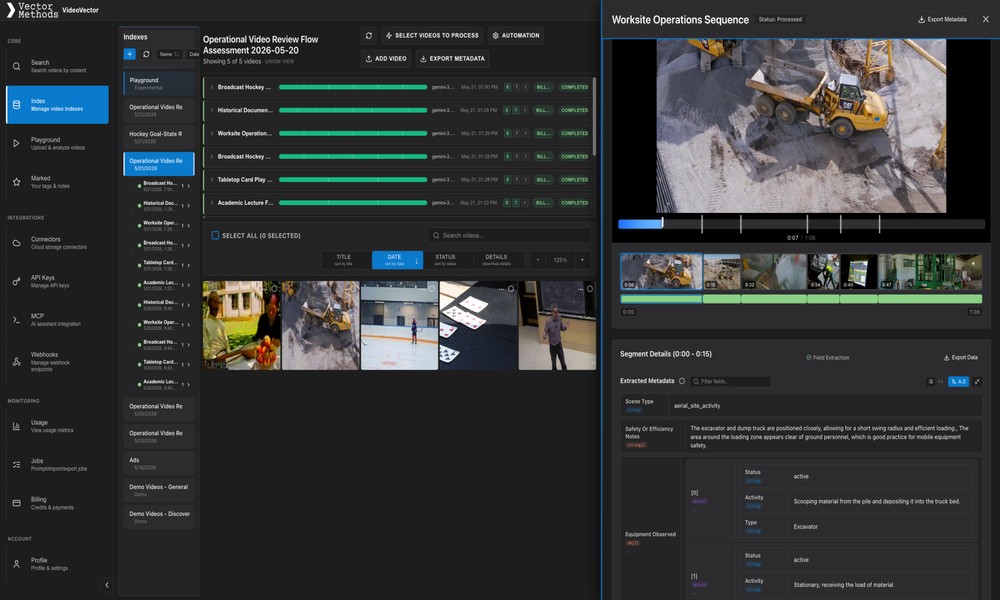
Most video AI demos stop at a caption, transcript, or short summary. That is not enough when an engineering team needs media data to power search, automation, review queues, recommendations, or VideoRAG. VectorMethods approaches the problem as infrastructure: raw video, audio, and images are transformed into structured intelligence that applications can query, validate, and route.
The core capability is LLM-based video extraction through the VideoVector platform. Instead of returning one generic paragraph about a file, VideoVector extracts time-stamped metadata, nested JSON, asset-level analysis, and search-ready descriptors. The result is useful for video scene extraction, video segment analysis, AI metadata extraction, and downstream pipelines where stable field names matter.
Consider an archive workflow. A single historical clip can contain spoken language, translated context, people, places, production cues, scene type, visual quality, and catalog descriptors. A transcript alone cannot capture that structure. With video metadata extraction, each moment can become a structured record: scene type, language, translation, visible entities, archival descriptors, search terms, and source timestamp.
The same pattern applies to operational footage, sports broadcasts, lectures, product videos, security media, and entertainment catalogs. A worksite video can expose equipment activity, safety states, process phases, and risk observations. A sports clip can expose play state, athlete visibility, highlight candidates, camera view, and editorial tags. A lecture can expose concepts, equations, board content, prerequisite ideas, and study notes.
The important technical detail is that extraction is not only file-level. VideoVector supports time-stamped segment outputs and asset-level synthesis. Segment outputs preserve source alignment, so an application can show the user the exact moment behind a field. Asset-level outputs consolidate the whole file into a canonical media record. This combination is especially useful for VideoRAG and MediaRAG systems, where retrieval needs both precise source anchors and broader context.
Schemas make the extraction programmable. With schema-aware video metadata extraction, teams can define the JSON shape they need instead of accepting a fixed vendor taxonomy. That means extracted outputs can be validated, stored in a database, indexed into search, sent to a webhook, or consumed by an internal API.
Once media is extracted, it becomes searchable. Time-stamped fields, asset descriptors, and metadata text can feed multimodal media search, vector search for video scenes and events, structured filters, SQL workflows, and agentic retrieval. The same extracted metadata can support human review, customer-facing discovery, archive search, recommendation systems, and automated media operations.
For technical teams, the shift is straightforward: video should not remain an opaque blob. LLM-based video extraction turns media into typed, time-aware records. VideoVector makes that process repeatable across media types, schemas, and downstream systems.
